
Why Some Rugs Cost Millions
There are area rugs that fetch multi-million dollar prices at auction. Why would someone pay so much?
Evan Whitehall
6/2/20262 min read
What’s so special about a rug that it costs north of $1,000,000?
Area rugs can cost a small fortune because of the materials used and the massive amount of time it takes to make them.
A $500,000 area rug resting underneath a masterpiece in The Met is going to be big, number 1. LOTS of material will be used.
Number 2, the materials used are fine wool, silk and gold in some cases. It gets pricey.
Number 3, there’s going to be more than 500 itty-bitty knots per square inch of rug, and they’re tied by hand.
Millions of fine knots are required to make a small palace-quality area rug. It takes the life-equivalent of a decade, in some cases.
A palatial rug might have 10 million knots in the arrangement with different colors, materials, and precious metals woven together.
These masterpieces are auctioned for more than $10 million in some cases if they have historical significance.
The best framework to think about area rugs is that they are artistic masterpieces, many of them one-of-a-kind.
They don’t go on a wall like paintings or a pedestal like sculpture…they go on the floor. Area rugs are functional artwork for your home.
They faithfully catch and hold dirt, sand, dead skin cells, hair, and anything else that touches it, and they can look good doing it.
The higher-quality the rug, the better it looks as it gets progressively soiled and worn.
The best wool area rugs can handle a big soil load and still look like artwork, and they keep their look for centuries.
Conversely, the cheapest polyester or acrylic rugs will get worn quick and look flat after a relatively light wear, as quickly as a year.
Just like a home's value, the foundation of any area rug is important and contributes to the overall value and longevity.
The foundation of the rug is called the "backing." Just like the foundation of your house, you never really feel, see, or interact with the backing of an area rug.
Backings are made from jute, nylon, cotton, glue, and other materials depending on what kind of rug is being made.
The more durable and flexible the backing, the longer the rug lasts.
The backing material is woven back and forth, up and down to form a mesh.
A machine weaves the strands fast, but humans do it best. The most valuable rugs are woven by hand, including the backing.
An area rug is finished by weaving longer, finer fibers through the backing, then tying them in place.
Machines can weave with high-precision at scale, but a hand-made rug has character that the machine-made counterparts can’t compare to.
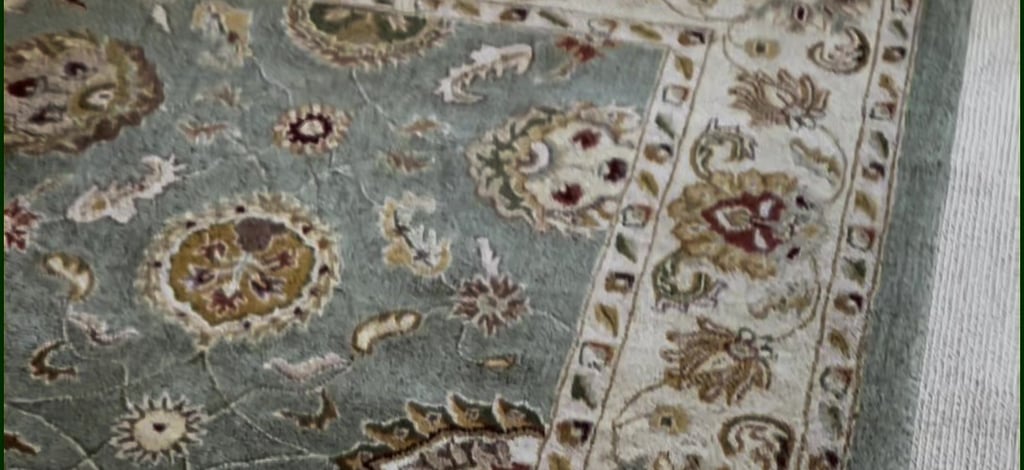
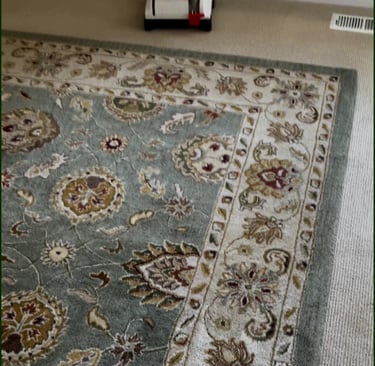
I recently cleaned an area rug that captures a rug’s character...
The rug had been passed down for three generations.
There were some bald spots where the backing was peeking out where kids had played over the years.
The dyes were still a vibrant blue, orange, white, teal, green, and purple. A truly amazing pattern and dye job.
The rug was originally from the middle east (Iran, formerly Persia), and had been imported by the patriarch of the family.
It will one day be passed to their grandchildren, because it has character and value.
It hadn’t been cleaned in over 10 years, but it still looked good.
After I cleaned it, it looked like art.
That’s what’s so special about area rugs.